
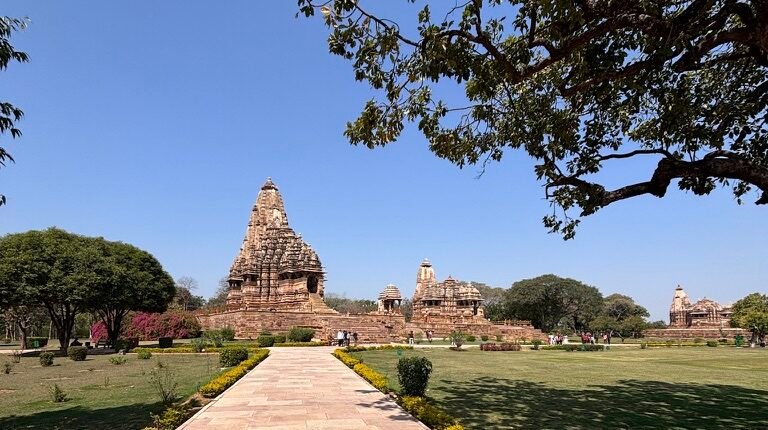
There are places you visit for their beauty, places you visit for their history, and then there are places that make you stop and wonder how human beings created something so extraordinary centuries ago.
Khajuraho is one such place.
Located in Madhya Pradesh, Khajuraho is famous around the world for its magnificent temples covered with intricately carved sculptures. But to reduce Khajuraho to its erotic sculptures would be a great injustice. Behind those famous carvings lies a remarkable story of art, spirituality, architecture, mythology and the extraordinary imagination of the people who built these temples nearly a thousand years ago.
A visit to Khajuraho is not simply a visit to a historical monument. It is a journey into India’s medieval past—where religion, art and everyday human life were carved together in stone.
A Glimpse into Khajuraho’s History
The temples of Khajuraho were primarily built between the 10th and 12th centuries, during the rule of the Chandela dynasty.
At its height, Khajuraho is believed to have had a much larger group of temples than what survives today. Around 85 temples are traditionally associated with the original temple complex, although only a few dozen survive.
Over the centuries, the importance of Khajuraho declined, and the temples became surrounded by forests and were largely forgotten outside the local region.
It was during the 19th century that the temples came to wider attention again.
Today, the surviving temples stand as some of the finest examples of the Nagara style of Hindu temple architecture.
The Western Group of Temples is particularly impressive and is also recognized as a UNESCO World Heritage Site.
The Western Group: The Heart of Khajuraho
If you have only one day in Khajuraho, the Western Group of Temples should be your first priority.
This beautifully maintained complex contains some of the most spectacular temples in the region.
The moment you enter, the first thing that catches your attention is not a single sculpture but the overall architecture. The temples rise upward in a series of towers and smaller spires, creating the impression of a mountain carved from stone.
Kandariya Mahadeva Temple
The Kandariya Mahadeva Temple is perhaps the most magnificent temple in Khajuraho.
Dedicated to Lord Shiva, it represents the architectural brilliance of the Chandela period.
Its towering shikhara dominates the complex, while hundreds of sculptures cover its exterior walls.
Look closely and you will find gods and goddesses, musicians, dancers, warriors, mythical creatures, animals and scenes from everyday life.
And yes, you will also encounter the famous erotic sculptures.
But they represent only a small part of the overall artistic story.
The temple is much more than its sensual carvings. It is a celebration of life in its many forms.
Lakshmana Temple
Another masterpiece is the Lakshmana Temple, dedicated to Lord Vishnu.
It is one of the best-preserved temples in the complex and is particularly impressive for the richness of its sculptural decoration.
Take your time here.
Instead of simply photographing the temple and moving on, walk around it slowly. Every section seems to reveal another detail.
A warrior, a musician, a celestial being, a mythical animal—you constantly discover something new.
Devi Jagadambi Temple
The Devi Jagadambi Temple is another important monument in the Western Group.
Although relatively smaller than Kandariya Mahadeva, its sculptures are equally fascinating.
The temple is associated with the goddess, and its elegant proportions and detailed carvings make it one of the highlights of the complex.
Why Are There Erotic Sculptures in Khajuraho?
This is probably the first question that comes to everyone’s mind.
Why did medieval Indian temple builders carve erotic figures on sacred temples?
There is no single universally accepted answer.
Different scholars have offered different interpretations. Some see the sculptures as representations of Kama, one of the traditional aims of human life. Others interpret them as a celebration of fertility, human existence and worldly life.
Another interpretation suggests that the temple walls portray the complete spectrum of human experience—from ordinary activities and celebrations to spirituality.
Whatever interpretation you prefer, one thing is clear: Khajuraho should not be viewed merely as a collection of erotic sculptures.
In fact, most of the sculptures are not erotic at all.
The walls portray dancers, musicians, animals, warriors, divine figures and ordinary aspects of medieval life.
Perhaps that is what makes Khajuraho so fascinating.
The temples do not present life as something divided neatly into “spiritual” and “worldly.” Instead, they appear to embrace the complexity of human existence.
Beyond the Famous Sculptures
One of the best things about Khajuraho is that you can spend hours simply observing the details.
Look at the expressions of the sculptures.
Notice the jewellery.
Look at the hairstyles.
Observe the musical instruments.
Look at the animals and mythical creatures.
The sculptors were not merely decorating walls. They were documenting an entire civilization in stone.
In many ways, Khajuraho is like a medieval encyclopedia—except that its pages are made of sandstone.
The Eastern and Southern Groups
While the Western Group receives most of the attention, Khajuraho has more to offer.
The Eastern Group of Temples includes several Jain temples and Hindu temples.
The Parshvanatha Temple is particularly notable for its intricate carvings and is one of the finest Jain temples in Khajuraho.
The Southern Group is smaller but worth visiting if you have additional time.
Exploring these lesser-visited temples can provide a quieter experience compared with the main Western Group.
Khajuraho at Sunrise and Sunset
There is something special about seeing these temples when the light is soft.
Early morning is ideal if you want to experience the complex in relative peace.
As sunlight touches the sandstone, the sculptures appear to change character. Shadows highlight the smallest details, while the tall temple towers seem to glow against the sky.
Evening is equally beautiful.
If you get the opportunity, spend some time simply sitting near the temple complex and watching the light change.
You may find yourself appreciating Khajuraho less as a monument and more as a work of art.
The Khajuraho Sound and Light Show
For visitors interested in history, the sound and light show can be an interesting addition to the trip.
It introduces visitors to the history of Khajuraho and the Chandela rulers through narration, lighting and visual effects.
It is particularly useful if you have limited knowledge of the history before arriving.
What Else Can You See Around Khajuraho?
Khajuraho is not only about temples.
The surrounding region offers opportunities to explore nature and wildlife as well.
The Panna region is within reach and can be combined with a Khajuraho trip for a broader Madhya Pradesh experience.
You can also explore local villages, museums and the cultural landscape around the town.
For travellers who enjoy photography, architecture and history, Khajuraho offers plenty of opportunities beyond the obvious postcard photographs.
Best Time to Visit Khajuraho
The winter months are generally the most comfortable time to visit Khajuraho.
October to March is a popular period because temperatures are more pleasant for sightseeing.
Summer can become extremely hot, especially during the afternoon, so early-morning sightseeing is preferable if you visit during the hotter months.
The monsoon brings a different character to the region, with greener surroundings, although rain can affect outdoor sightseeing.
How Many Days Are Enough?
For a first visit, 2 days and 1 night can be enough to see the major attractions without rushing.
Day 1
- Western Group of Temples
- Kandariya Mahadeva Temple
- Lakshmana Temple
- Devi Jagadambi Temple
- Local market
- Sound and Light Show
Day 2
- Eastern Group
- Jain temples
- Southern Group
- Local sightseeing
- Optional trip towards Panna
If you are passionate about history, architecture or photography, spending an extra day can make the experience much more relaxed.
How to Experience Khajuraho Properly
The biggest mistake you can make in Khajuraho is rushing through the temples.
Don’t treat the visit as a checklist.
Don’t simply arrive, take photographs of the famous sculptures and leave.
Walk slowly.
Look closely.
Read about the Chandela period before your trip.
Try to understand the symbolism.
Notice the architecture.
Imagine the effort required to carve thousands of figures into stone without modern machinery.
And most importantly, look beyond what Khajuraho is famous for.
Because once you do that, you begin to understand that the real story of Khajuraho is not about erotic sculptures.
It is about life itself.
Final Thoughts
Khajuraho is one of those rare destinations where history does not feel distant.
It surrounds you.
It stands in front of you in the form of towering temples and intricate sculptures. It appears in the faces of dancers carved into stone. It echoes through the stories of gods, warriors and ordinary people.
Nearly a thousand years have passed since the Chandela rulers built these temples, yet their artistic vision continues to attract travellers from across the world.
Perhaps that is the greatest achievement of Khajuraho.
Stone was supposed to be lifeless.
But here, somehow, stone comes alive.
And that is why Khajuraho deserves to be experienced—not merely seen.